About Meadfleet
Meadfleet are an award winning public open space management company, taking care of over 300 residential, new-build developments across England and Wales.
Traditionally the remit of a land management company is to ensure that public open spaces are maintained to provide safe, tidy, attractive green space on and around housing developments. The Meadfleet board and management team believe that we should also maximise and celebrate the biodiversity potential of our sites.
We must strike a balance to maintain amenity value for local residents who contribute towards the costs of green space maintenance whilst also managing these spaces as diverse wildlife habitats. Our team includes two in-house ecologists to ensure developments are managed to encourage biodiversity.
In 2019 we implemented a Bee Friendly campaign, making enhancements to benefit pollinating insects, creating new habitats, and engaging residents in the campaign. We are partnered with Buglife, a charity dedicated to conservation, education and policy change to protect insects, bugs, and pollinators.
Persona, Leeds
In 2014, Yorkshire-based developer, Strata, entrusted the open spaces on Persona, an 86-property development to the west of Leeds, to Meadfleet. Having created an attractive development of high-quality homes for their customers, we were thrilled to be asked to expand on Strata’s success and preserve their legacy for the future.
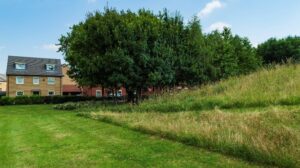
The 3.4 acres of open space at Persona have been designed to provide habitats and food for wildlife and to deliver amenity value to residents. These areas incorporate:
- Native hedgerows such as hawthorn, mature trees including birch, ash, and oak, and shrub beds containing pollinator-friendly plants including hebe.
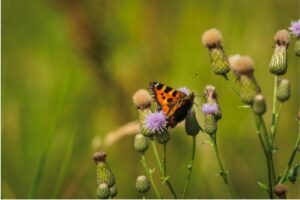
- A large wildflower meadow including Creeping thistle, Birdsfoot trefoil, and Rose-bay willowherb.
- A pond and wetland area surrounded by willows providing valuable forage to spring pollinators such as solitary bees and newly emerged queen bumblebees.
Sustainable Management
Since 2014, we have sympathetically and expertly maintained the areas of open space to maximise the benefits to residents and wildlife. In addition to a carefully devised programme of routine maintenance, we have implemented initiatives to improve biodiversity:
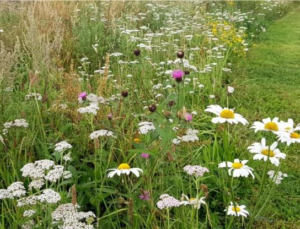
- The large, attractive wildflower areas are managed to promote the growth of native species. These areas provide pollen and nectar for herbivorous insects and provide a range of nesting, egg laying and shelter opportunities. They are cut annually once flowering has finished with the cuttings left for a short time allowing seeds to drop and establish for the next year’s growth. Cuttings are then removed to lower nutrients in the soil which benefits the wildflower by reducing competing species.
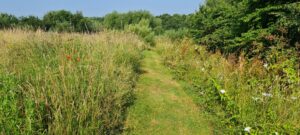
- Mown paths have been implemented through the wildflower and pond areas to provide definition and enable users of the area to enjoy walks through these naturalised areas.
-
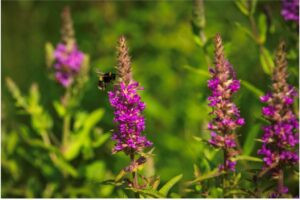
White tailed bumblebee on Willow herb Shorter grass areas are left at a length that allows low-growing wildflowers such as clover and selfheal to appear which benefit bees and other insects. These provide structural variation to the grasslands with the interfaces between short and long grasses useful to invertebrate species and other wildlife.
- A habitat or ‘Hibernaculum’ has been created close to the pond providing a safe place for wildlife such as voles, frogs and grass snakes to shelter. The marginal vegetation surrounding the pond offers habitat for herptiles, such as Great crested newts.
- We have donated 500 sqm of additional native wildflower and nearly 3000 bulbs including daffodils, bluebells and tulips to improve the open spaces further for the benefit of pollinators and to provide attractive displays of colour.
With guidance from Buglife, our future plans include the addition of Wild garlic to provide early blooms for bees, the implementation of a bee bank to offer nesting resources plus further variations in vegetation heights to enhance habitat diversity.
Buglife Pollinator Survey

In 2021 we invited Dr Catherine Jones from our partner charity Buglife, to Persona, to assess the open spaces, the impact of our work there and to provide expert guidance for further improvements. During the visit, species including White-tailed bumblebee, Tortoiseshell butterfly, Great pied hoverfly and Musk beetle were spotted. Dr Jones commented:
“The large wildflower meadow area, with wildflowers and long grasses provide pollen and nectar for pollinators and vegetation for herbivorous insects to eat, and provide a range of nesting, egg-laying and shelter opportunities. Short cut grass paths through the meadow area enable users to engage with the wildlife on the open space.
Overall, this area of open space, which is maintained for both wildlife and amenity use, support a good range of habitats across the development. These provide a diversity of food resources and shelter options for invertebrates across their life cycle – from egg-laying or nesting sites to pupation and hibernation sites.”
We look forward to continuing our partnership with Buglife to further improve biodiversity on Meadfleet open spaces.