
Led by our team of ecologists, our operations department are continually identifying ways in which we can enhance the open spaces in our management for biodiversity. Whilst existing residential developments are not affected by Biodiversity Net Gain (BNG) regulations, our improvements follow the principles of BNG, ensuring the biodiversity value of an area is enhanced.
With practical experience of successfully managing areas of open space for biodiversity and relevant in-house expertise and knowledge, Meadfleet can offer housebuilders the long-term solution to managing the requirements of BNG either on their developments or on offsite land.
This is one example of a project we undertook on a development near Pontefract known as ‘Instinct’. The scheme was built by Strata and the open spaces handed over to Meadfleet in 2013.
In the example below our team used the Biodiversity Net Gain methodology to assess habitat types and conditions, and programme a schedule of works to enhance the biodiversity value.
Site information, history and assessment
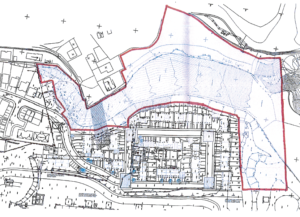
Maps from the mid nineteenth century indicate that the area was formerly part of Ackworth Moor Top Far Quarry, and in the early twentieth century maps show the area occupied by the Seals buildings, also known as the Bullring. Later maps have no record of the land use of the area.
Today the site consists of a long, wooded embankment, with semi-mature self-set sycamore trees and a number of Norway maple trees, the locations of which suggest the trees were planted. This section of the woodland is surrounded by a chainlink fence.
Adjacent to the east is a recent housing development, and to the north is a woodland dominated by pedunculate oak trees, which is used for recreation by the local community. To the west of the woodland is a footpath, further woodland and Hessle Brook.
During a site assessment by the Meadfleet ecology team the woodland was identified as showing potential for habitat improvements. The dense canopy cover of non-native sycamore trees provided limited opportunities for the development of native ground flora, and harsh conditions for the success of the few native woody plant species present such as holly and elder.
Biodiversity improvements identified
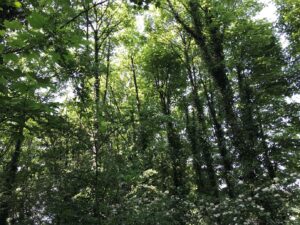
To implement habitat improvements the site was surveyed by our ecology team, with vegetation and habitats classified using the UKHab methodology. The survey was undertaken within the field season to ensure that all habitats could be appropriately assessed, and so that once classified the habitats could be subject to Condition Assessments. The habitat across the fenced area of woodland is classified as ‘Other woodland; broadleaved’, and the condition of the habitat is classified as ‘poor’. The dominance of non-native tree species, lack of diversity in age structure, lack of diversity in ground flora and presence of invasive non-native plant species contribute to the ‘poor’ condition result.
Based on the findings of the survey and research into the fauna, flora and ground conditions of the local area, habitat improvements were planned to enhance the habitat, initially to raise the condition of the habitat from ‘poor’ to ‘moderate’.
As the area had been measured and the baseline data had been gathered to accurately assess the habitat type and condition, the Biodiversity Metric was used to generate a ‘score’ for the habitat as it was at the time of survey, and a projected value of the habitat following works to reduce the number of sycamore, plant native tree species, diversify the ground flora and remove the invasive non-native species. The Biodiversity Metric result is that the improvement works would generate 2 Biodiversity Units.
Undertaking the habitat improvements
Meadfleet are using the Instinct woodland improvement works as a case study to follow the Biodiversity Net Gain process and to educate and train all the members of our Operations Team in habitat assessment, monitoring and practical management techniques. A Habitat Management and Monitoring Plan (HMMP) was prepared and followed to ensure that the target habitat condition is achieved.
The initial work involved identifying and marking sycamore trees to be felled. Trees were assessed for their proximity to each other and the extent of their canopy. A felling licence was obtained from the Forestry Commission to enable the lawful felling of the trees, and all trees were first assessed for their potential to support protected wildlife. Once all checks were satisfactorily completed the trees were felled by professional tree surgeons, and all logs and brash were retained on site.

The Meadfleet Operations Team attended the site for two workdays in February 2024. The team cleared the woodland floor of the felled material to create habitat piles from the brash and logs, which will benefit a variety of wildlife from fungi to invertebrates and small mammals.
Over 250 saplings of native tree species were planted in selected locations throughout the woodland, and areas of ivy were cleared from the ground as experimental areas so that natural regeneration of ground flora can be monitored. Native woodland wildflowers lesser celandine and wood anemone were planted across the woodland. Some non-native ornamental plants were found to be growing in the woodland, these were removed and used to stock shrub beds in the areas of public open space in the adjacent housing development.
May 2024 update
Our Ecology & Conservation Manager Paul Cassidy visited the area with Operations Manager, Emlyn Craven to see how the area had progressed since the works were completed.
They were delighted to see that the improvements made in February had already made a big difference. The clearance of the non-native trees has allowed sunlight in and the woodland wildflowers to flourish, plus, the new native trees were establishing well. Whilst there, Paul and Emlyn glimpsed a queen bumblebee checking out one of the newly created log piles. It is very encouraging to see these initial improvements having a real impact.
During the May visit, Paul took some footage to demonstrate the improvements:
Next Phase of Biodiversity Improvements
The next phase of the improvements will be in summer 2024, when a work party will be organised to clear invasive non-native species Himalayan balsam from the woodland. This visit will also provide an opportunity for the team to be involved with the monitoring of the initial success of the works and to shadow the ecologist in their annual survey of the woodland.

The Biodiversity Net Gain improvements involve a 30-year commitment, and the habitat management and monitoring works will continue throughout this period.
Learn more about BNG and Meadfleet’s management of open spaces for biodiversity.
Follow us on LinkedIn to keep up to date with the latest on Biodiversity Net Gain