
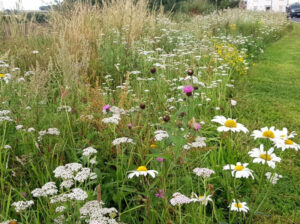
We receive fantastic feedback from our residents about the native wildflower patches and meadows that Meadfleet create on the public open space we care for.
Whilst we are creating and managing large meadow areas on the open spaces around your development, we can all provide even more valuable habitat for butterflies, bees and other important pollinating insects by enhancing our gardens. Meadfleet are donating free packets of wildflower seed so that everybody has the opportunity to grow their own wildflower patch. Even a small area of your garden, or plant pots or troughs, can support your own mini-meadow. Not only will you be helping local wildlife, you will be creating a display which will add colour and structure to your garden.
How to sow wildflower seed:
Seed is best sown between March and November. The species in the mix are:

- Musk mallow
- Lady’s bedstraw
- Teasel
- Common knapweed
- Selfheal
- Wild carrot
- Oxeye daisy
Most of the flowers are ‘perennials’ – they will establish leaves in the first year and then flower every following summer, although some may flower in the first year.
It is recommended that seeds are sown into bare soil, here are some tips:
Planting in the ground

- Prepare a small patch of ground – generally 3 grams of wildflower seed will cover 1 square metre
- Wildflowers will fare best with no competition from other plants, so choose a bare patch in a shrub bed, or remove a section of turf to expose bare soil
- Rake over the soil to break up the surface and loosen the soil
- Scatter the seed across the bare soil and lightly rake the area to give a thin covering of soil to the seeds
Planting in pots, planters, troughs or raised beds
- Fill your container with topsoil, either from your garden or from a purchased bag of soil – keep a few handfuls of soil aside
- Generally pots, planters and troughs with holes in the base placed in a saucer or tray provide the best moisture control for plants
- Lightly compact the soil, and scatter the seeds on the surface. Ensure enough space for the leaves to develop – generally 3 grams of seed will cover 1 square metre
- Finally scatter the remaining handfuls of soil to cover the seeds.
Depending on the time of year and weather conditions your newly sown seeds may need watering to keep the soil moist and help them to establish.
Maintenance
- Other than watering the establishing wildflowers should require little maintenance
- Check for and remove any unwanted species around the new flowers as they grow, e.g. grasses
- Once your wildflowers have finished flowering wait for seed heads to form. The seeds can be collected and scattered around to create new wildflower patches
- Once all plants have gone to seed then they can be cut down in late summer / early autumn. Remove the cuttings, do not allow them to rot down on the soil as this returns nutrients to the soil, encouraging unwanted plants which may compete with your wildflowers in the future
- The cut material can be composted or stacked as a small habitat pile in the corner of a garden, providing a useful shelter for invertebrates over the winter.
We would love to see photos of your wildflower area – please send any you would like to share to communities@meadfleet.co.uk

About Meadfleet
Meadfleet are a leading sustainable land-adopting management company. We have in-house ecologists with expertise in the BNG metric and are already applying the principles of Biodiversity Net Gain across our existing open space portfolio in England and Wales. Established in 1995, Meadfleet manage over 330 developments and 42,000 residential properties in our portfolio, with a strong balance sheet.
Meadfleet offers management of Biodiversity Net Gain delivery both on a managed development and on offsite areas, either via customer contributions or commuted sums. Our adoption model relieves developers of ongoing liabilities and management costs.
The Meadfleet model removes onerous liabilities from homeowners yet still encourages their input and engagement into the management of their local environment. We are committed to providing an excellent service to residents as demonstrated by our Excellent rating on Trustpilot and are members of The Property Ombudsman Scheme (TPOS), offering customers free, independent redress should they feel it is required. We are happy to work with residents groups and positively encourage the creation of these on the developments we are involved with. We believe this opens an effective two-way dialogue between homeowners and ourselves.
As a land-adopting management company, Meadfleet take long-term responsibility of open space, building customer and community relations and implementing perpetual management and improvement plans. We take a holistic and independent approach to managing areas of open space for the benefit of all residents, biodiversity and the wider environment.