
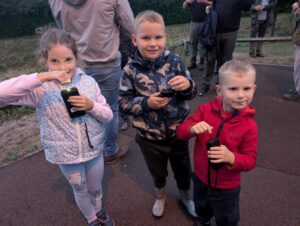
In late August and September, as the summer nights begin to draw in, it is an ideal time to look for bats. As bats are nocturnal the earlier sunsets give everybody a chance to see bats without staying out too late. We love to encourage our customers to learn more about the nature on their doorstep, and so every year the Meadfleet Ecology Team lead a number of Bat Walks.
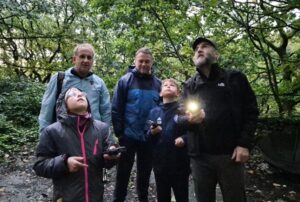
This summer we worked with residents’ associations to organise Bat Walks at our Wyndham Park development in Somerset, and at our Fountainhead Village development in West Yorkshire. People of all ages joined the team to find out some fascinating bat facts and to see (and hear) bats using the public open spaces. We visited a variety of habitats including meadows, woodlands and watercourses to find a variety of bats. Bat detectors were used to enable everybody to hear the calls made by bats as they forage and navigate across the landscape. A number of different species of bats were identified, including common pipistrelle, soprano pipistrelle, brown long-eared bat and Daubenton’s bat. All the attendees were thrilled to see the bats flying so close to the group, and to hear the variety of calls. People we also amazed by some of the bat facts, including the fact that pipistrelles can eat up to 3,000 insects in one night!
Meadfleet’s relationship with bats is not limited to leading public events – we are also responsible for a number of bat roosts within our developments, including an underground roost of lesser horseshoe bats at a development in Somerset. We visit regularly to check the roost and its inhabitants. The video at the bottom of this post was taken on our most recent visit – we use a red light to minimise disturbance to the bats as we check the structure of the building and count the number of bats present. Our team are licenced by Natural England and Natural Resources Wales to enter bat roosts, and if necessary to handle bats.
We manage our open spaces to maximise biodiversity, with our planting schemes designed to provide habitat for a variety of invertebrates including pollinating insects. As a bat’s diet consists of insects then our open spaces provide wonderful foraging habitat, and our drive to plant new hedgerows and trees creates landscape features to facilitate the bats’ commuting across the landscape. We also provide donations to our customers to encourage them to make their gardens more wildlife-friendly, with recent giveaways including wildflower seed to create a mini-meadow to attract pollinators.
We are always happy to involve customers, community groups, schools and other organisations in our programme of events – if you would like us to lead a bat walk or similar event then please don’t hesitate to get in touch at communities@meadfleet.co.uk

About Meadfleet
Meadfleet is a leading sustainable land-adopting management company, established in 1995. We manage over 350 developments and 40,000 residential properties across England and Wales, supported by in-house expertise and decades of experience.
Our in-house ecologists bring expertise in Biodiversity Net Gain (BNG), and we offer management of BNG delivery both on managed developments and offsite areas, funded through customer contributions or commuted sums. Our adoption model relieves developers of ongoing liabilities and management costs.
The Meadfleet approach removes onerous responsibilities from homeowners while encouraging resident engagement in the stewardship of their local environment. We are members of The Property Ombudsman Scheme (TPOS), providing customers with free, independent redress if required. We also welcome and support resident groups, creating a valuable two-way dialogue that strengthens community involvement.
As a land-adopting management company, we take long-term responsibility for open space, building strong community relations and implementing ongoing management and improvement plans. Our independent, holistic approach ensures open spaces are managed sustainably for the benefit of residents, biodiversity, and the wider environment.