
Last week, Meadfleet had the pleasure of visiting the Circa development in Cheltenham to lead a community bat walk across the open space. Our Ecology and Conservation Manager, Paul Cassidy, led the walk together with Regional Manager Tony Hobbs, and Assistant Ecologist, Grace Brady.
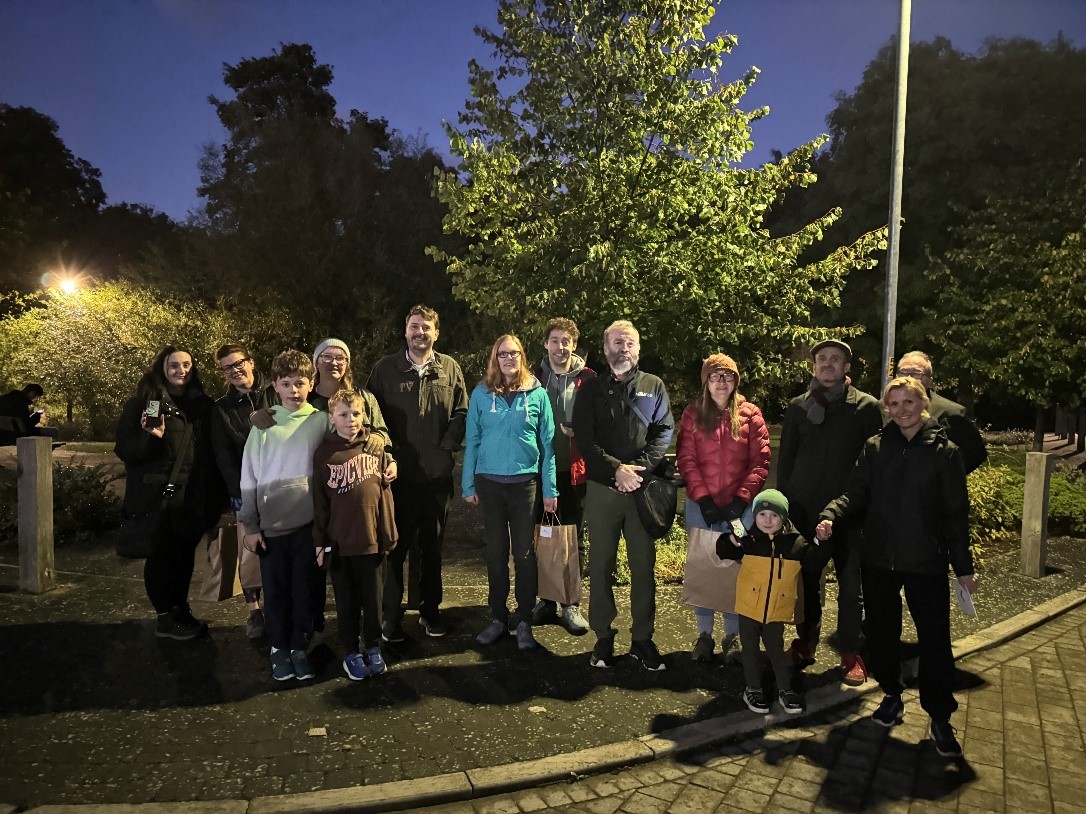
The event began with an informative talk by Paul on bats, their ecology, and the species that we might encounter during the walk. In the UK, there are 18 species of bats, many of which are found in both urban and rural settings. Species that are more likely to be spotted include the common pipistrelle, soprano pipistrelle, noctule bat, daubenton’s bat, and the brown long-eared bat.

Pipistrelles, for instance, are the smallest British bats and often roost in buildings, while noctules, one of the largest species, prefer open spaces and are often seen flying higher in the sky. Daubenton’s bat, on the other hand, is known for its close association with water. Often called the “water bat,” it skims low over ponds and rivers, using its large feet to catch insects from the water’s surface. The brown long-eared bat is particularly distinctive for its large ears, which give it enhanced hearing to detect the faint rustles of insects in vegetation.
Residents were handed bat detectors, devices that allow us to hear bats’ echolocation calls, as they flew overhead. Echolocation is an essential tool used by bats to navigate and hunt in the dark. By emitting high-frequency sound waves, the bats can detect objects in their surroundings when the sound bounces back as an echo. This process helps them identify the size, shape, distance, and texture of objects, like trees, insects, and buildings.
Did you know a bat can eat over 3,000 insects in one night?!
Each bat species has a distinct call with different frequencies, which bat detectors convert into audible sounds for us to hear. For example, the common pipistrelle echolocates at around 45 kHz, while the soprano pipistrelle calls at a higher frequency of around 55 kHz. Listening to these calls provides a unique way to differentiate between species that we may spot.
The group set off across the development shortly after sunset, and we were quickly greeted by the distinctive smacking sound of soprano pipistrelles as they darted through the air, using their echolocation to hunt for insects. However, as the temperature dropped, the cold began to affect insect activity, and the bats ceased hunting for the night.
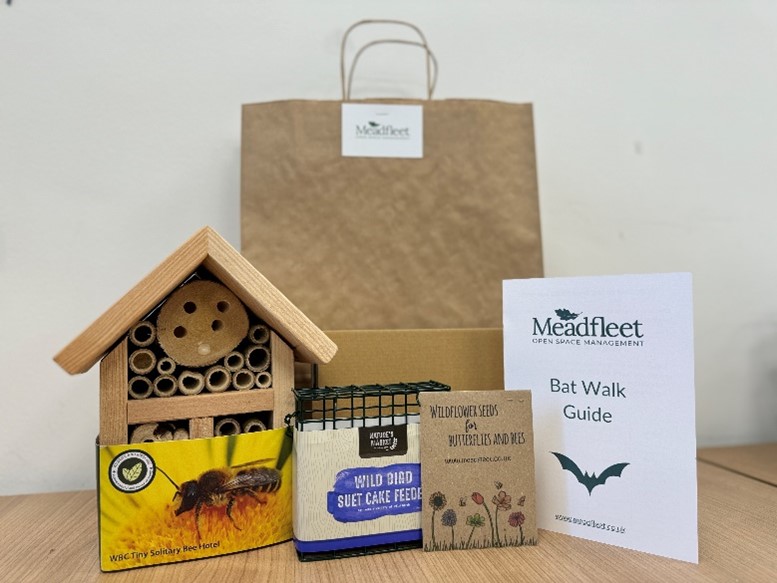
Before the walk came to a close, we handed out goody bags to the residents. These included a build-your-own bat box to provide a place for bats to roost, wildflower seeds to attract insects for them to feed on, a bee hotel, and a bird feeder to support other local wildlife.
We were delighted to see residents so interested in exploring and learning more about the wildlife in their local area. Events like this allow us to share the benefits of our ecology-led approach to open space management and highlight the positive impact it has on local wildlife. We look forward to more opportunities to connect with the community and lead more events like this in the future. Education and engagement are key to understanding the broad range of benefits our ecological approach offers. By fostering this awareness, we can ensure that amenity and biodiversity are harmoniously balanced for the future.
Our Ecology Team love to help our customers, schools and community groups to learn more about the nature and wildlife in their local area, and we are always looking for new groups to work with – please visit our Community page for more information.
About Meadfleet
Meadfleet are a leading sustainable land-adopting management company. We have in-house ecologists with expertise in the BNG metric and are already applying the principles of Biodiversity Net Gain across our existing open space portfolio in England and Wales. Established in 1995, Meadfleet manage over 330 developments and 42,000 residential properties in our portfolio, with a strong balance sheet.
Meadfleet offers management of Biodiversity Net Gain delivery both on a managed development and on offsite areas, either via customer contributions or commuted sums. Our adoption model relieves developers of ongoing liabilities and management costs.
The Meadfleet model removes onerous liabilities from homeowners yet still encourages their input and engagement into the management of their local environment. We are committed to providing an excellent service to residents as demonstrated by our Excellent rating on Trustpilot and are members of The Property Ombudsman Scheme (TPOS), offering customers free, independent redress should they feel it is required. We are happy to work with residents groups and positively encourage the creation of these on the developments we are involved with. We believe this opens an effective two-way dialogue between homeowners and ourselves.
As a land-adopting management company, Meadfleet take long-term responsibility of open space, building customer and community relations and implementing perpetual management and improvement plans. We take a holistic and independent approach to managing